written by ed; photos by jayne
(First, let me begin this post by apologizing to those on follow.it for the Sweden post not appearing. It was not the fault of follow.it rather, it was the fault of the blogger!)
It wouldn’t have been a proper goodbye to CPH unless Peter and Bowie accompanied us to the train station as we made our way to Sweden. And so it was, with Bowie in tow in the train, Peter ensured that we made our next train connection to Malmo, Sweden without any complications. We said our sad goodbyes, knowing that we would see one another somewhere, sometime in the future.
The 40 minute train ride to Malmö was easy and smooth as no passport was required upon arrival. We were then going to take a bus to the airport to receive our rental car which we would have for the next 14 days exploring western Sweden but decided to rent the car from the train station rather than waiting for a few hours for the next bus. While waiting for our car, we checked out Malmö and were immediately struck by how much more racial diversity there was compared to Denmark. The difference in the immigration policy of Sweden is much different from Denmark’s as it has opened its doors to African, Southeast Asian, and Middle Eastern refugees much more liberally.
After enjoying a bowl of pho at Mrs. Saigon’s Vietnamese restaurant, we looked over our itinerary, if you can call it that, and realized that the reservation we thought (actually it was what I thought) we had for that evening was actually for the following night. One of the great things about traveling without a set itinerary is that if a mistake such as this happens, no worries, we make other plans. And we did.
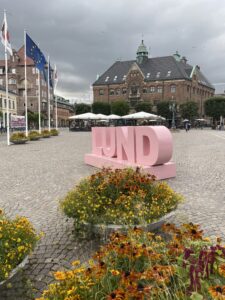
We stayed that night in Lund, not only known for its university, but also for its massive Lutheran medieval cathedral. Lund Cathedral has been called “the most powerful representative of Romanesque architecture in the Nordic countries”.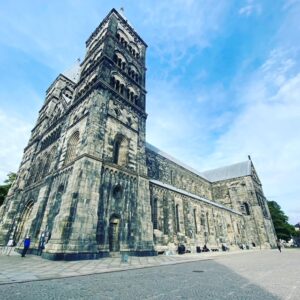 I don’t think I’ve ever been in a church as huge, but more than its size was recognizing the age of the structure. Granted it has undergone renovations over the years, but to think that the main altar was built in 1134 reminds you of how old the rest of the world is when compared to the US. It’s awe-inspiring to think about.
Off to Sofiero Palace, one of the Swedish royalty’s country mansions now a public property. It had spectacular grounds with different sections of flowers, forest, and a sculptured hedged labyrinth.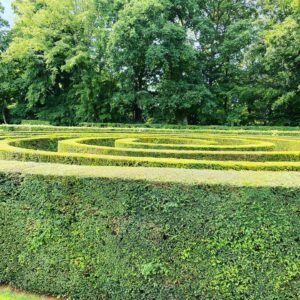
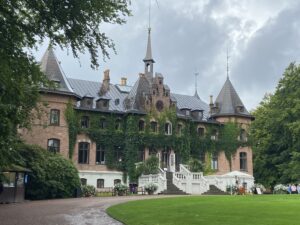
Our next stop was Söderåsen National Park, where we had a great stay at a bed and breakfast just outside the park. 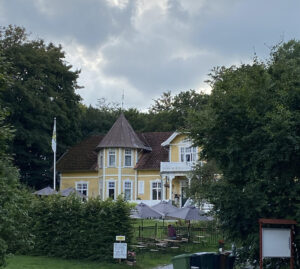 Upon arrival, we took a short hike to a beautiful lake and when finished enjoyed a delicious lentil stew from a food stand named Sababa, run by a guy from Brooklyn, who looked like a svelte Tevya from Fiddler on the Roof!
We woke up early (for us) the next morning and took a 4.5 mile hike through a forested trail that kept us dry as the rain trickled down throughout the walk. 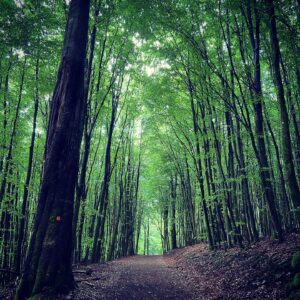
The next morning we made our way to the coast and the resort towns of Molle and Varberg. 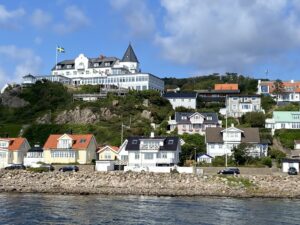 It was the most amount of tourists we had seen in a while, virtually all unmasked. (From what we understand, the west coast of Sweden has largely been vaccinated, but on the east coast the Delta variant is hitting younger Swedes). Most of these tourists were probably Swedish who head this way for a summer weekend. Varberg
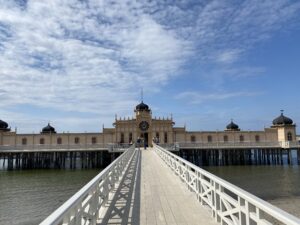 had a beautiful Moorish-style bathhouse that had been restored as well as homes overlooking the seaside harbor. Relaxed at a café having calamari (me) and a halloumi salad (Jayne). After walking around the harbor, we ventured off to the tip of the peninsula to a nature reserve called Kullaberg with its historic lighthouse and sea views.
We stayed that evening in an Airbnb, which was a farm stay out in the middle of nowhere. Our GPS couldn’t find the location because Airbnb hadn’t updated the correct address, so we called Ingemar (our host, who spoke minimal English) 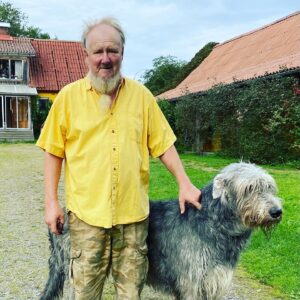 who asked his wife, Boel, to meet us at the lone petrol station in a nearby town (Hishult). She escorted us to their small farm where, among other things, they make award-winning blue cheese, and it was delicious. Ingemar also offered to make us some dinner, which we graciously accepted and spent a nice evening in a very quiet location.
(The picture to the right is of Ingemar and his wolfhound)
Driving in western Sweden, generally speaking, has been easy, with most Swedes obeying the posted speed limits, (maybe it’s because there are many speed cameras on the roads, even the rural ones) and there is virtually no honking of horns or road rage, as we know it. Most of the driving thus far has been in Skåne County, which appears to be mostly agricultural with large farms, some cattle, and horses along the way, with very little traffic. Really, the only difference is the number of roundabouts you encounter. Fortunately, having driven in Australia, I’m fairly familiar with roundabouts, but man, there were plenty of them!
As we approached Gothenburg, Sweden’s second-largest city after Stockholm, it became obvious that driving would be a bit more, let’s say intense, as the number of cars increased and the city isn’t that car-friendly due to its emphasis on maintaining a green philosophy. In fact, a few years ago, Gothenburg was named the greenest city in the world.
More on Gothenburg and our continued travel up the west coast, in a few days (maybe!)