written by ed; photos by jayne
Flight time to Aswan from Cairo is about an hour, yet it felt in some ways, a world away. Aswan is near the southern border of Egypt and Sudan, at the base of the Nile River, and through antiquity was a commercial and strategic gateway for the country. The original Aswan dam was built in the early 1900s and was insufficient in controlling floods so after the Egyptian Revolution of 1952, the new government made as one of its priorities, the building of a new Aswan High Dam (completed in 1970), to not only control the flooding, but also to preserve some of its archeological sites, promote irrigation, and provide hydroelectricity to the country. As an example, our guide. Mo, who grew up in Luxor, told us that his family did not have electricity until he was 7 years old in 1979 and the dam was a game-changer for the country.
Given Aswan’s close proximity to Sudan, the region has many people of Nubian descent. Nubians are indigenous to this region and have their own dialect and traditions and typically darker-skinned, but they certainly consider themselves Egyptian. We stayed in a Nubian village, with its brightly colored homes, at a small hotel, that sat just a few feet from the Nile. With the Kato Dool Hotel as our base for a few days, we basically kicked back and explored the small village with its tourist-oriented market and surrounding area.
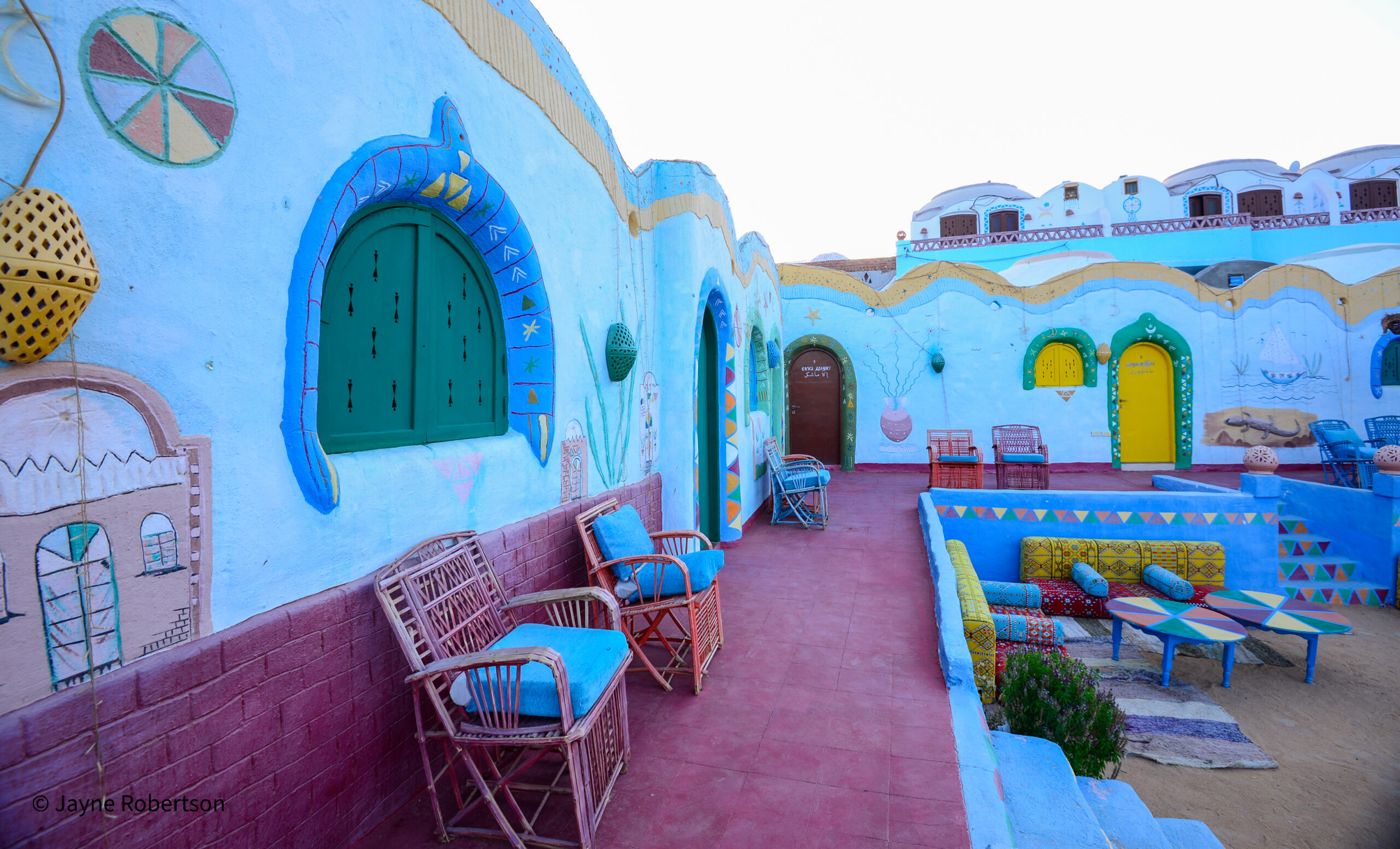
Kato Dool Hotel
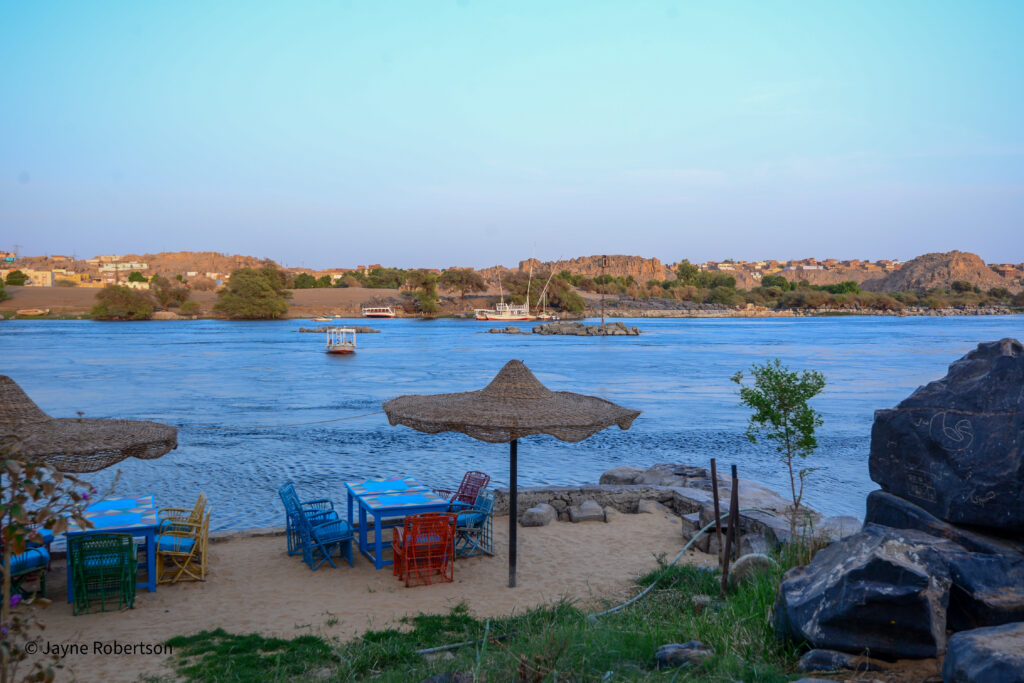
Elephantine Island, a strategic transport hub in ancient times was a short boat ride away, so we visited a small museum on the island with its ancient artifacts. The island, apparently, was the site of an ancient Jewish temple (400B.C.), something we learned after our visit. We completed our outing with lunch in Aswan and a visit to the Nubian Museum.
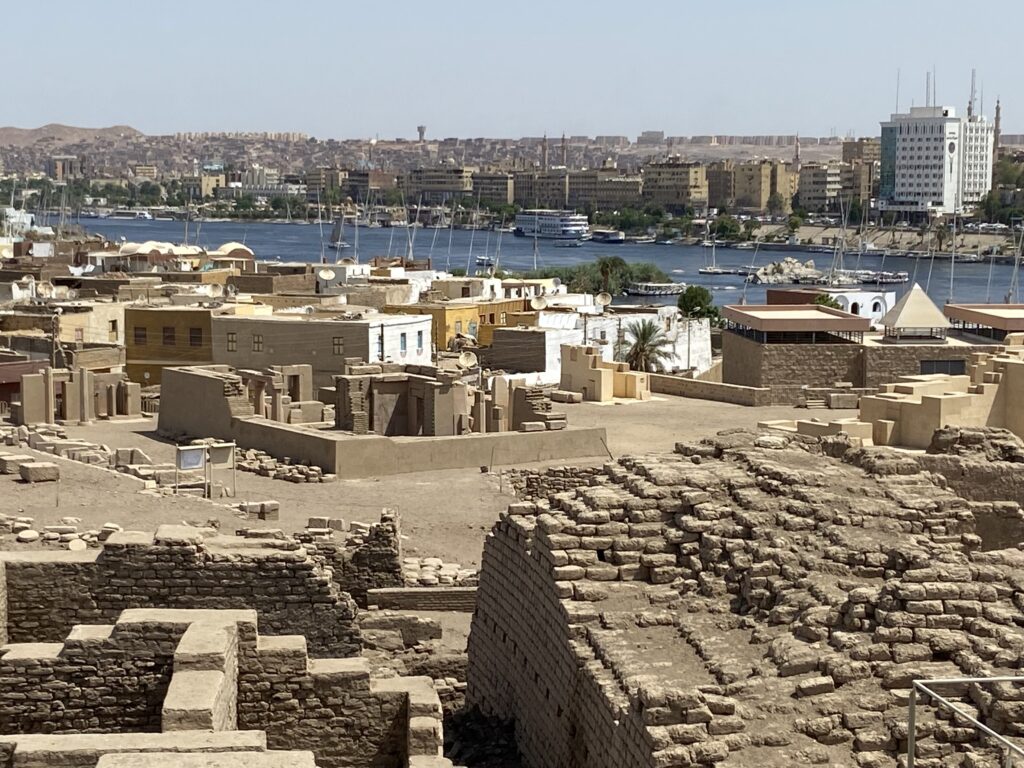
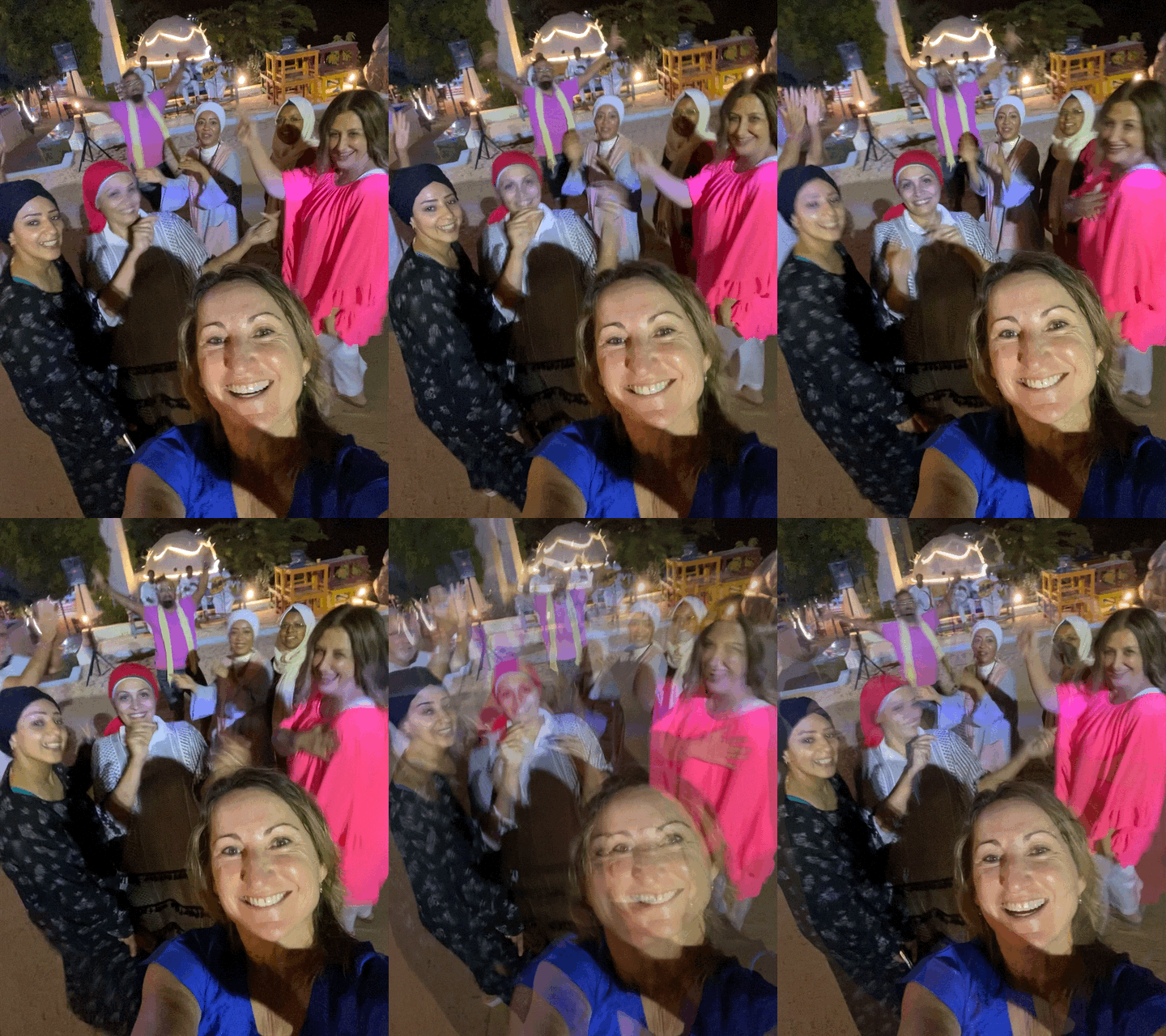
That evening, the owner of our 10-room hotel, said there was going to be some entertainment. The entertainment arrived in the form of three musicians: an oud (fretless stringed instrument, like a lute) player and two tablas (drums) players. Jayne had been talking to some Egyptian women from Cairo, who worked with pediatric cancer patients using art and music therapy and were also guests at the hotel. Before long, almost everyone from the hotel (all 8 of us!), started dancing to the music. One of the women, who didn’t speak any English, grabbed Jayne’s hand and started to teach her the steps to a dance. Within a matter of minutes and, much to the surprise of everyone watching (but not to me), Jayne had the steps down pat and a new friendship began.
Although only one of the women spoke English, the music and dance created a means of communication that transcended language. As you might expect, Jayne now has a few more Instagram followers!
Having had a few days to relax, we were now ready to explore the Upper Nile with all its temples and monuments. We were met at our hotel by our tour guide, Mohammed (Mo), and the driver, Mohammed, at about 9:30 am, much to the surprise of our hosts at the hotel who were expecting us to leave at around 4:30 am! Apparently, that is the time most tourists visit, as it’s a 3-hour drive to the Abu Simbel complex, and you don’t want to be there in the heat of the day. Well, we hadn’t really been told that bit of information and so, since we were ex-desert rats, well, we could handle the heat. About halfway into the drive, we stopped at a cafe for a break and we noticed that there were cars and buses coming from the opposite direction – the groups who had left at 4:30 am were on their way back to Aswan. As it turned out, we made the right decision, because even though it was a bit toasty, we had the whole complex virtually to ourselves during our visit. Our 20 plus years of time in the desert of Palm Springs had served us well!
Abu Simbel was one of the archeological sites threatened by the rising waters of the Nile and the building of the Aswan High Dam. It is considered by many to be the most iconic of all of the rock-cut (as opposed to stone-built; think Mt. Rushmore on steroids!) temples in Egypt. Construction of these huge temples began in 1264 B.C. and was completed 20 years later. The temples were built as monuments to King Ramses II and his most beloved wife, Nefertari. The temples fell into disuse and were eventually covered by sand. In 1813, a Swiss explorer, Burckhardt, discovered the top part of the relief, and then in 1817, Italian explorer, Belzoni, managed to enter the temple complex. The salvage of the temples began in 1964, under the auspices of UNESCO, and is now a UNESCO World Heritage Site, known as the Nubian Monuments. The relocation of these monuments onto higher ground was one of the most remarkable feats in archeological history. The structure was broken into, on average 20-ton blocks, then dismantled and reassembled about 250 meters back from the river. Amazing!
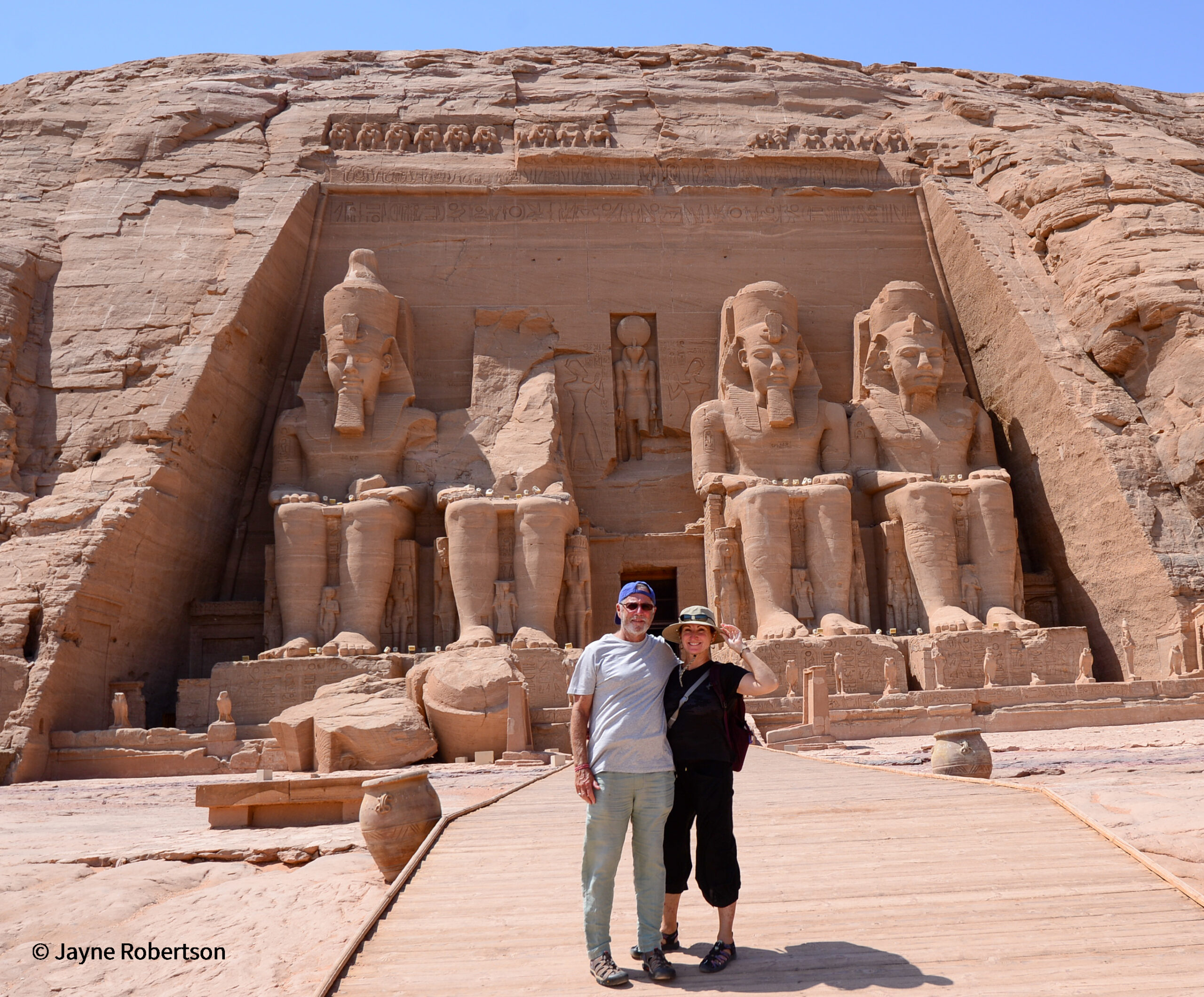
As you might imagine, with any iconic structure, words just cannot do them justice. I remember when we visited the Taj Mahal ten years ago that feeling of wonder of being in its midst, even though I’d seen so many images of it over the years. Likewise, the feeling I experienced seeing Machu Picchu after hiking the Inca Trail. I’m sure all of you have had similar experiences. Being in the presence of extraordinary works of art or the beauty of natural wonders is both humbling and awe-inspiring. Jayne’s photos will have to suffice rather than my words.
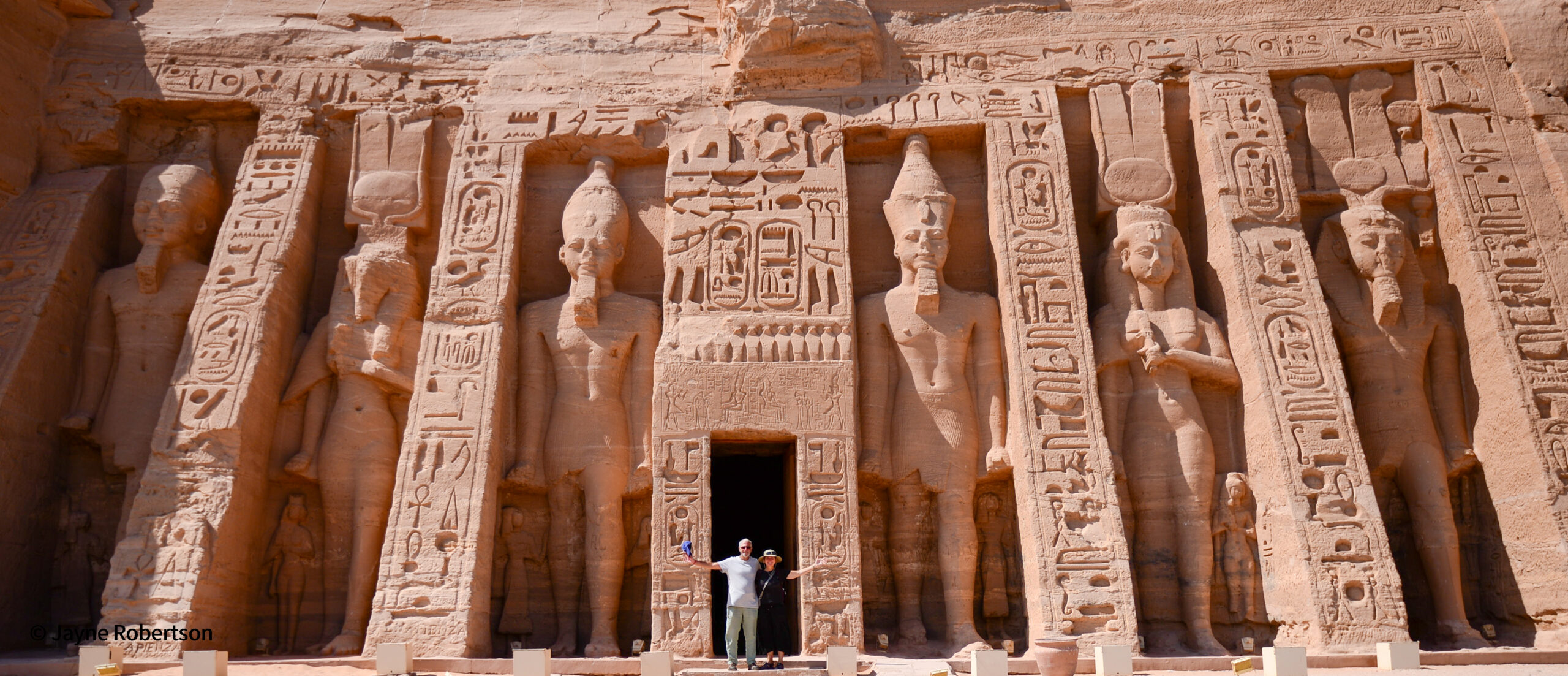
Close by was the Temple of Philae, originally built to honor the Egyptian god of the deceased, Osiris. This temple complex had been flooded several times during the building of the original Aswan Dam, so as part of the UNESCO project for Abu Simbel, this complex was dismantled and moved to a small island on Lake Nasser.
What also made the experience so memorable was Mohammed’s knowledge of the history of the monuments, his explanations of the relief drawings, and his reading of the hieroglyphics. Having someone like Mo as our guide and teacher throughout our stay in Aswan and Luxor was undoubtedly one of the trip’s highlights. We spent many hours with him over the course of the next 4 days and, aside from his intellect, he shared some of his own personal views and perspectives, which made the time with him extra special.
The following day, the plan was to board the cruise ship we would take to Luxor, in the late afternoon so we had the morning free. Mo offered to take us to a “real” (meaning non-touristy) Nubian village that morning, and so we hopped on the “locals” ferry and headed to the east bank of the Nile a short 10-15 minute ride away. The boat was divided into 2 distinct sections – one for women and children and the other for men. As we sat waiting for all to board, I nudged Mo and briefly told him about the blog I wrote about being “the other” in a Kenyan hospital emergency room. He smiled. This was definitely another one of those moments where you could feel and sense the gazes. I just smiled inside as this was just another one of those experiences that makes travel so rewarding.
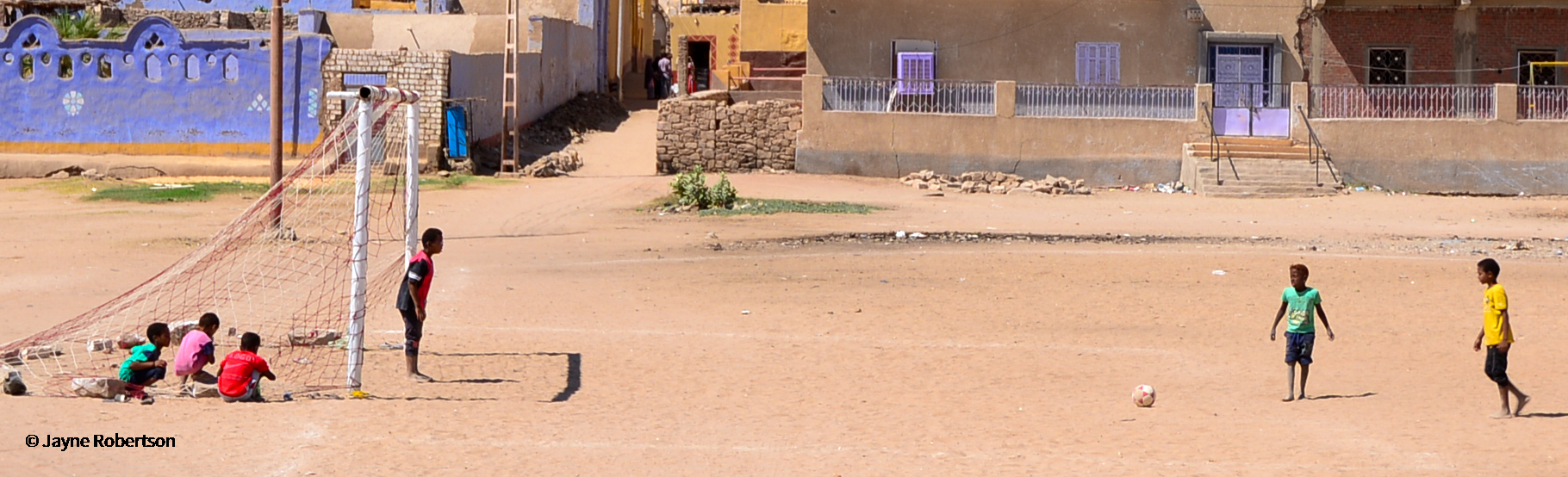
Strolling through the village, it was obvious this was not a place tourists would necessarily visit – we certainly would not have had it not been for Mo. There were no souvenir shops, no hassling with shop owners, just a fair amount of ogling at us. We were definitely an oddity. But we found it was easy to make people comfortable with us and smile. As but one example, we passed a field where a bunch of kids was practicing their soccer skills. As we passed a bench of older men watching the kids, I yelled G-O-A-L, pretty loudly, as they do on TV when a goal is scored. The boys looked over to where we were standing, a good 50-100 yards away, and started laughing as did the men on the bench. The kids liked it so much they kicked some more goals with me again yelling G-O-A-L! This lasted only a couple of minutes but it was great to see smiles on everyone’s faces, including mine!
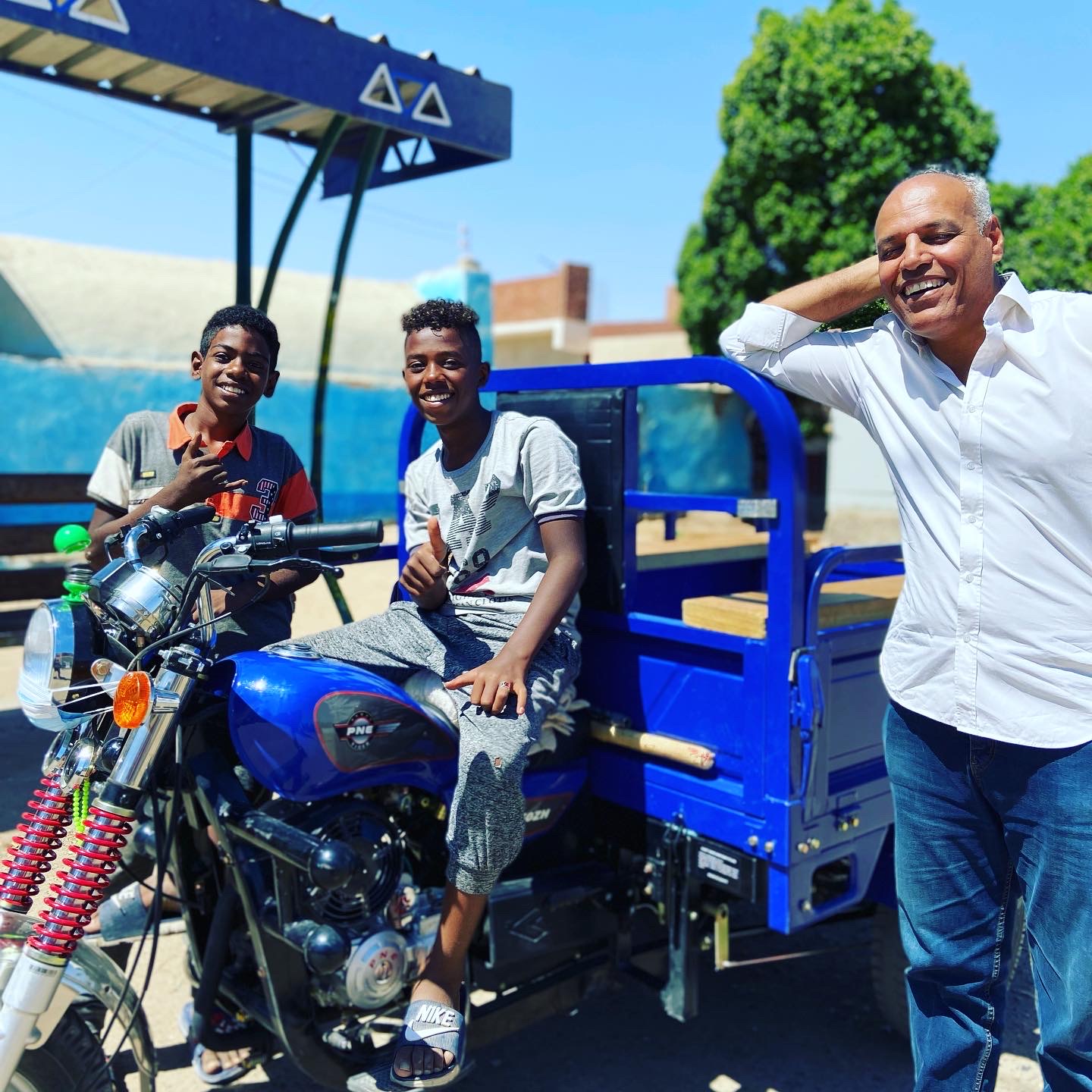
We decided to take a tuk-tuk (basically, a motorized rickshaw) ride back with a couple of young boys who couldn’t have been more than 14 years old, and kiddingly asked (through Mo) to see their driver’s license. They just smiled like, “are you joking?”.
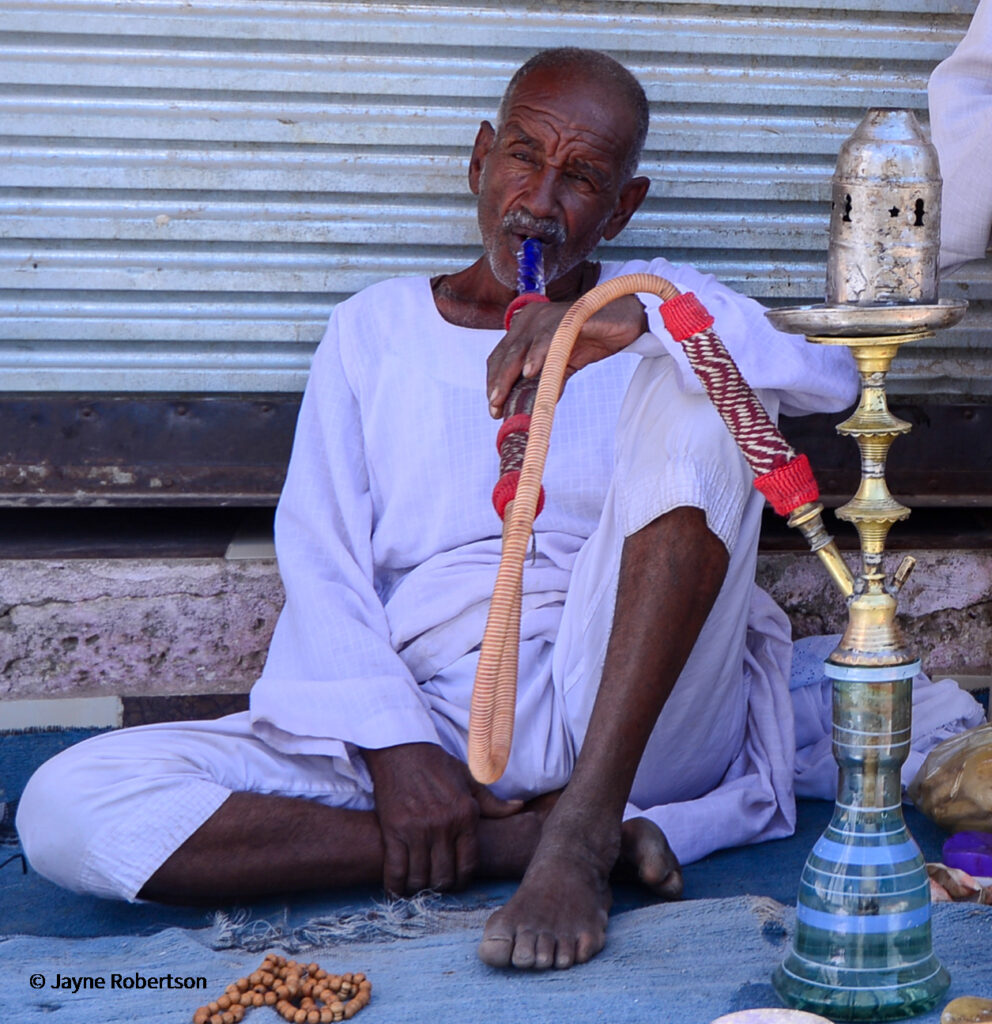
Along the way, we saw some men casually sitting and enjoying a shisha break. They kindly accepted our request to take their picture.
Oh, one final bit of trivia about Nubian homes – they like to keep crocodiles as pets! It’s a little unclear as to why this is so. We heard from one person that it’s a totem of protection for the home and, doing some research, one Nubian remarked that the Nile represents life to Nubians, and all creatures who dwell there are angels. OK, but why crocs?
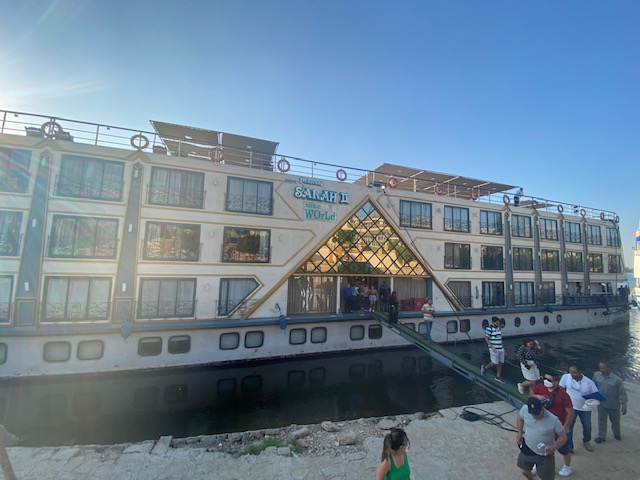
Anyway, with our morning outing completed, we were ready to board our cruise ship, the Princess Sarah, and set sail on our Nile Cruise – the final destination of Luxor.