written by Ed
Typically, you wouldn’t think of a hospital emergency room as a place where one gains insights into their biases (conscious or otherwise), stereotypes, privilege or being “the other”, yet that’s where my mind crept as I waited patiently (uh, maybe not so patiently) for a diagnosis of a red, swollen calf in Nairobi, Kenya. Jayne and I were to leave for Egypt the following day, and my concern was that I might have deep vein thrombosis (DVT), a condition, that our good friend and Dr. of Physical Therapy extraordinaire, Mark Thomson, who had been diagnosed with DVT a year earlier, said not to take lightly and suggested a Doppler ultrasound.
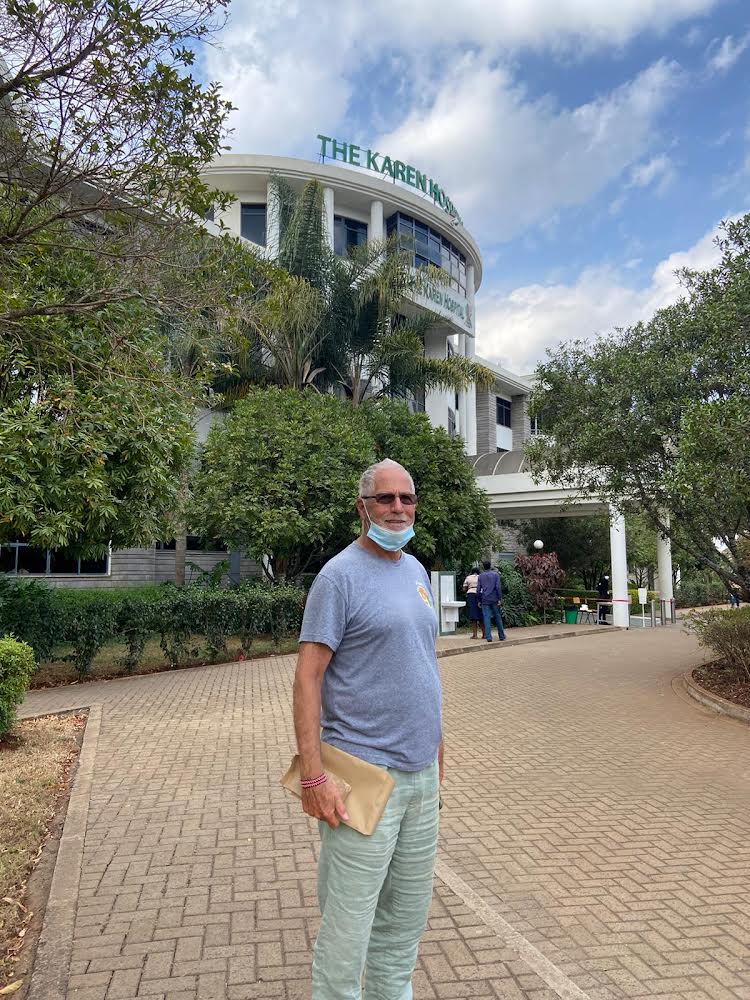
Our hosts at the Wildebeest Eco-Camp called the local hospital (Karen Hospital) to find out the process for me to be evaluated and treated. We had been told previously that if possible, try and avoid being treated in a Kenyan hospital as their medical system (whatever that means) is inferior to what we might experience in Egypt, for example. Even had I not been told this, my bias as a US citizen, would corroborate that view. Yet, I really had little choice due to our impending travel plans. So, off we went to Karen Hospital.
After checking in and explaining why I wished to see a doctor, I waited for the intake process of my vitals being taken. I then waited to see a doctor, who said that she could not be certain that it wasn’t DVT, and recommended the ultrasound. Our interaction was professional and very matter of fact. I then paid for the ultrasound ($80 USD), and waited to be taken for the imaging. So, you can see there was a fair amount of waiting involved, not unlike what you might experience in any waiting room anywhere in the world.
There was one difference though: Jayne and I were the only white people (actually we did see a couple of other white patients over the 3.5 hours we were there) in the areas we waited. Many thoughts went through my mind, first and foremost, did I have DVT and, secondly, I wondered how I was being viewed by others, the people in the waiting room, the admin staff and the doctor, all of whom were black. I was acutely aware that I was different, that I was “the other”. I began to empathize with minorities everywhere who experience being the “other” every single day.
Many of you who know my background, know that my parents were liberal thinkers, active in civil and human rights issues their entire lives. They raised their children to go beyond the color, religion, or any other identity differentiator of people, and recognize that all people are interconnected, even if they may not have used those words. So, I was fortunate and so grateful to have had that upbringing and have, either intentionally or otherwise, sought out situations and experiences where I was the “other”, as I believe it enhances empathy, something so lacking in the polarized US. It’s one of the things I so enjoy about travel, understanding that there is a wide array of ways to live, and to withhold judgment on another’s way of life. Travel affords you the opportunity to wear another set of lenses, ones that make you view your world and the world around you differently.
As my eyes caught the glances of those across from me, I couldn’t help but ask myself – Who are these people? Where do they live? What jobs do they have? What hopes do they have for themselves and their families? And likewise thinking they might have similar questions – Who is this white man sitting across from me? What is his story? Why is he here? Lots of questions and lots of scenarios I can only imagine. It made the waiting less tedious.
I’m finally taken into a room for my ultrasound. Although the equipment looked outdated, the technician seemed quite confident. As he applied the gel and waved the wand for several minutes, he assured me that I did not have DVT, just varicose veins. I’m pretty convinced that the hours I spent on safari, where we sat for 4-5 consecutive hours, combined with the lengthy road trips contributed to the poor circulation in my legs. I waited for the printed report and returned to the doctor.
With great relief, the doctor reassured me that I did not have DVT and recommended some heparin cream for the calf. It was then, that we each felt comfortable enough with one another and curious about one another that we began to ask each other more personal questions. One of those questions, was about my travels. When I explained to her that we had sold our house and cars and were traveling the world nomadically, her eyes absolutely lit up and I could see her smile behind her mask so vividly. She looked at me with some disbelief and said, “I want to be you when I grow up!” I returned her smile and we each said, “have a nice life” to one another as I left her office.
It was those words, “I want to be like you when I grow up”, that reinforced for me the notion that people the world over share the same hopes and dreams. Countless times I have heard those exact or similar words spoken as I’ve shared our travel plans with others, whether it was the newlywed from the UAE or the 21 year old boatman from Lamu. That yearning to travel and the learning experience it affords us seems to be one that is universal.
So, this emergency room experience had a happy ending insofar as my physical condition is concerned. It also served as a reminder that when one is present and curious, we can see how interconnected people are, regardless of what they look like, what God, if any, they worship, or any other differentiator – we all want the same things – a safe place to live, food to eat, a good life for our children and to be happy and content in our lives. Travel soothes my soul!









[…] were to leave for Cairo in a couple of days and I had experienced some swelling in my left calf, (I reviewed that adventure in a previous post!) so we made a plan to go to the hospital after visiting the David Sheldrick Wildlife Trust. Over […]